Every day we
interact with the world around us on various levels. At the most personal level
we interact with the snooze button of our alarms, and the “brew” Button of the
coffee maker. Then our interaction with the world around us takes a step the
moment we turn on the tv, or our laptops, we are bombarded with a wave of
information about the world stock exchange and the current political situation
at home and abroad. With that one push of a button we are participants in our
local, national and international world, though we hear about far off places
where there are struggles, we secretly think to ourselves that it will never
happen here. With today’s culture we dismiss other people by saying they are
different from me and we don’t stop to observe what we do have in common. As we
examine the history of design all over the world it becomes clear that the
foundations of design are all essentially related.
In the first week of
class the mantra “object, space, building, place” was introduced. Also we
talked about scale, by watching “the powers of ten” by Charles and ray Eames. Most
importantly we talked about the universal circles. We began our journey and analization
of architecture with Stonehenge, and its purpose. Was it meant to be a sundial,
or an alter for the afterlife because of the circle of burial mounds just
downstream of Stonehenge. So we stared with the most fundamental shape that
repeats and evolves into new shapes throughout time.
Then in week two we
continued with the “building blocks” of architecture, with the theme of
Circles, Groves and Stacks. We discussed how all buildings are made from these
three structures or a combination of these three and how they came from nature.
Circles are from the sun and moon, Groves are like a man made forest and stacks
are like the layers of the human body. We talked about the idea of a prototype,
and archetype and a hybrid. We looked at an example of this in columns. There is
the Tuscan, the prototype, then there are the most well known the Doric, Ionic
and Corinthian, the archetypes, and from them came the hybrid the composite.
 Then in the third
week we investigated parts of Greek and roman design that appear again and
again throughout design, the column. We talked about the Doric, Ionic, and
Corinthian columns, and the essential organization parts of a building, the
porch, the court and the hearth. We talked about the acropolis as an example of
these basic structures but these also show up in Egyptian culture in their
temples. In the acropolis there are steps that lead up to the acropolis which
has the porch, then in the middle of the acropolis there is the court and the
hearth was in the middle section of the Erechtheion. We also saw columns in the
Xi’an palace that held the terracotta warriors, had many columns around the
outside and was stacked to look taller.
Then in the third
week we investigated parts of Greek and roman design that appear again and
again throughout design, the column. We talked about the Doric, Ionic, and
Corinthian columns, and the essential organization parts of a building, the
porch, the court and the hearth. We talked about the acropolis as an example of
these basic structures but these also show up in Egyptian culture in their
temples. In the acropolis there are steps that lead up to the acropolis which
has the porch, then in the middle of the acropolis there is the court and the
hearth was in the middle section of the Erechtheion. We also saw columns in the
Xi’an palace that held the terracotta warriors, had many columns around the
outside and was stacked to look taller. 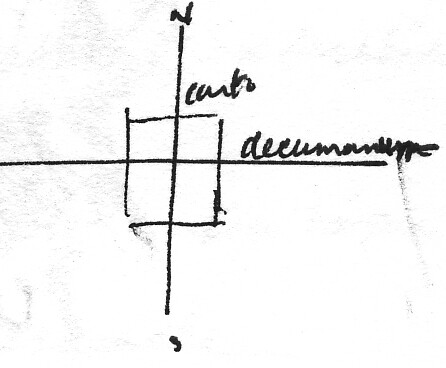
Then in the fourth
week we talked about commodity, firmness and delight (utilitas, firmitas, and
venustas). Commodity is how well the space can function. Firmness is how strong
the space is and Delight is the aesthetic appeal of the space. We talked about
the Roman empire and how they had planned cities each with a cardo and
decumanus, two streets that ran north-south, and east-west. Also each Roman
city had aqueducts that brought clean water for drinking and bathing. In any
Roman city there were a number of gathering places such as the baths,
basilicas, the market and the forum. Roman cities also had a number of
entertainment venues like the coliseum and the Amphitheatre. Also there came
two major pieces of architecture, the arch and the dome. These two pieces will continually
show up again and again in design history in churches and large buildings, and
still do today.
In this unit we have
explored a range of ideas and concepts that will continue to grow and change as
we learn more about design history. If we look back at these basic form of
design there is always a connection and it is vital that we never forget our
connections to the whole world.